The Narrative
A data-driven exploration of how gender and geography shape MoMA’s collection, revealing the patterns of visibility, exclusion, and institutional power behind the narrative of modern art.
MoMA, Modernism, and Gender
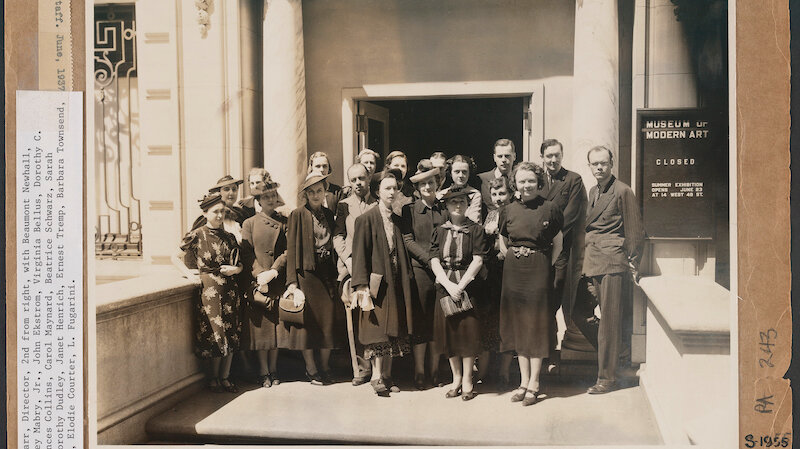
The representation of women artists in MoMA’s collection has evolved significantly over the institution’s long history, and that evolution mirrors broader historical shifts in cultural attitudes, museum priorities, and feminist critiques. When MoMA was founded in 1929, it established itself as the narrator of modernism in art, and here we can see the broader context for all gender-based patterns in the collection of art.
Courtesy of Kuribayashi Ayuko
MoMA’s Acquisition Patterns Over Time
MoMA’s collecting history has never been linear. Understanding when MoMA was actively acquiring art is necessary to contextualizing patterns of representation in the collection.

Figure 1. Number of Artworks Acquired by MoMA (1929-2024)
A line chart visualizing the number of artworks MoMA acquired each year since its founding.
This chart reveals that MoMA’s collecting activity is not steady or even, but occurs in waves; we see a major spike in the 1960s, followed by additional spikes in the 2000s and 2010s. These peaks indicate moments when the museum expanded its holdings more aggressively, often due to new funding, new leadership, or major shifts in curatorial strategy. This backdrop matters because representation depends not only on who MoMA considers significant, but when the museum is actively acquiring at all. The early decades have lower acquisition volume, aligning with MoMA’s formative years, which is precisely the period in which the institution built a masculine canon and largely ignored women artists.
From the get go, the museum’s collecting and exhibition practices overwhelmingly favored male artists, establishing a narrative that aligned modern artistic progress with male creativity. Carol Duncan’s essay “The MoMA’s Hot Mamas” published back in 1989, critiques this imbalance, showing how the museum not only excluded women from its lists of “great modern masters” but actively reinforced patriarchal narratives through the types of artworks it elevated (Duncan). Duncan argues that the MoMA built its artistic identity around male creators whose works often sexualized women rather than showcasing them as subjects of art. This baseline institutional logic shaped the museum’s early decades of cataloguing, during which women artists appeared only sporadically, and as exceptions rather than contributors to the core story of modern art.
Griselda Pollock’s analysis in Modern Women reveals just how deeply this exclusion was woven into the MoMA’s collecting regimen. As Pollock notes, MoMA’s earliest collecting decisions were guided by Alfred H. Barr Jr.’s vision of modernism, a narrative focused on stylistic innovation and linear progress, but defined almost exclusively through the work of men. Pollock explains that this narrative was “self-perpetuating,” because once the “masters” of modernism were identified, the museum’s acquisitions, exhibitions, and scholarship reinforced those choices, creating a narrative in which women were almost entirely invisible (Pollock). Within this system, women artists were not omitted by accident, but rather, were structurally excluded by a definition of artistic importance that mirrored the gender hierarchies of the early twentieth century.
Anna Jacobson’s article, Women at MoMA: The First 60 Years argues that while female curators and staff were foundational to the Museum of Modern Art’s early identity and success, their contributions have been systematically overlooked by its historical narrative (Jacobson).
Women, no matter their contributions, were positioned outside the lines of influence drawn by the museum’s founding curators.
Gender Representation
This table presents the number of unique artists in MoMA’s collection across gender categories, and it makes MoMA’s historical patterns of exclusion visible in numerical form. Male artists outnumber female artists by a ratio of roughly four to one, reflecting the deeply gendered structure of the museum’s collection. The extremely small numbers of transgender, nonbinary, and gender-nonconforming artists further demonstrate how narrowly MoMA’s institutional gaze has historically been focused.
Even more striking is the large “Other / Unknown” category, which includes over 3,200 artists whose gender was not recorded. This absence is not a neutral omission. As Pollock argues, missing demographic metadata is itself a form of institutional erasure: marginalized creators were not documented with the same care as their male counterparts, and their identities were deemed irrelevant to the museum’s narrative.
Because this table reflects unique individuals rather than repeating instances, it provides a clearer picture of representation; each artist is counted only once, revealing the true scale of gender disparity within the collection. The numbers show that even when women are present, their representation remains limited, and marginalized gender identities are all but invisible in MoMA’s historical record. This data underscores how the museum’s construction of modernism has been shaped by exclusion, selective visibility, and uneven documentation.

Figure 2. Number of Unique Artists by Gender
A table showing how many distinct artists of each gender appear in MoMA’s collection.
This early institutional bias is precisely what Carol Duncan highlighted when she analyzed MoMA’s treatment of the female body in its core collection (Duncan). Works such as Picasso’s Les Demoiselles d’Avignon or de Kooning’s Woman I are, according to Duncan, signs of a modernist tradition that eroticizes, sexualizes, or even distorts the feminine body while celebrating male artistic genius. The museum’s persistent emphasis on such works, which were displayed as milestones of progress, reinforces the idea that women belong only as subjects within art, not as creators. Duncan writes that MoMA’s displays create a “masculine viewing position,” inviting the visitor to identify with the male creator who holds control over the depicted female form (Duncan). Her essay implicitly underscores the absence of women artists behind the canvas, pointing out that if women appeared so frequently as eroticized bodies in the museum’s galleries, they appeared only rarely as the artist behind those images. MoMA hereby produced a double erasure of women, marginalizing their authorship while also showing women primarily as visual objects.
Pollock’s analysis provides historical background for this imbalance. She notes that throughout much of the twentieth century, MoMA acquired women’s artworks in limited quantities and often relegated them to specialized exhibitions instead of central displays of their modernist “main narrative” (Pollock). For example, women’s artworks were featured in themed or media-specific shows such as photography, design, or crafts, but were rarely included in the museum’s major displays. This selective representation meant that women’s contributions were seen only as adjacent to modernism, not integral to its formation. Pollock emphasizes that this was not because women lacked innovative practices but because their work did not fit MoMA’s preexisting criteria of artistic progress which had only included males’ innovation from the beginning. As she writes, the museum’s early collecting practices “shaped and limited” the story of modern art in ways that made it difficult for women to be recognized as contributors within that story (Pollock).
Gender Proportions by Birth Decade
Birth decades reveal generational patterns, historical biases, and how representation shifts (or fails to shift) over time.

Figure 3. Percentage of Artists by Gender per Birth Decade
A 100% stacked bar chart showing gender representation across artist birth decades.
This 100% stacked bar chart illustrates changes in the gender composition of artists within the MoMA dataset, organized by “Birth Decade”. Each decade’s bar is normalized to 100%, so we are viewing gender proportions rather than absolute numbers. Overall, males have long dominated across multiple decades. It is also evident that the proportion of females increased gradually from the late 19th century to the mid-to-late 20th century, showing that female artists have gained greater visibility in more recent birth decades.
Nonbinary and transgender categories remain extremely small across all decades. The chart also includes notable “Other / Unknown” values, particularly in the decades around 1760, 2000, and 2010, which reflect incomplete or inconsistent gender metadata in MoMA’s artist records. Early records may be incomplete, while more recent data may not yet be fully supplemented. Moreover, these missing values themselves represent a form of “data silence,” reminding us that the historical processes of museum documentation and classification determine who is more likely to be seen and who is more likely to be overlooked.
For artists born between the 1850s and early 1900s, men dominate nearly every bar, with women represented only as a thin sliver. It is not that women were not making art but rather that MoMA’s curatorial framework did not have space for them. Pollock argues that because MoMA defined modernism through almost exclusively attributing innovation to male figures, women were systematically positioned outside the narrative (Pollock). However, when we move into the mid-20th century, the proportion of women begins to rise, reflecting growing opportunities for women in the art world and increasing pressure on institutions to recognize them. The gradual widening of the female segment in the bars shows that the shifts in representation correlate with historical feminist movements and changing attitudes toward gender equality.
Women in MoMA’s New Acquisitions
The line chart showing the percentage of new acquisitions by women per decade makes this connection explicit. Women’s presence in new acquisitions remains extremely low in MoMA’s early years, then begins to rise dramatically between the 1970s and 1990s. This aligns directly with the rise of second-wave feminism, the activism of groups like the Guerrilla Girls, and the intellectual interventions of scholars like Duncan and Pollock. Duncan’s critique—that MoMA perpetuated a masculine art historical narrative—became impossible to ignore as feminist art historians exposed how the museum invisibilized women creators while foregrounding male artists depicting “hot mamas” and eroticized female bodies. The uptick in acquisitions can be understood as an institutional response to this sustained critique. Yet the chart also reveals that progress is uneven: the rise in the late-20th century plateaus in the 2000s, reflecting stagnation before a more recent resurgence in the 2010s and 2020s. This stop-and-start trajectory suggests that institutional recognition is neither automatic nor guaranteed; it must be continually pushed forward.

Figure 4. Women as a Percentage of New Acquisitions by Decade
Line chart showing % of newly acquired artworks created by women.
Artists Across the Globe
To understand MoMA’s patterns of inclusion, it is important to examine where its artists come from.
Women in MoMA’s New Acquisitions

Figure 5. Top Countries Artists Are From
A bar chart showing the most represented artist nationalities in MoMA’s collection.
Women in MoMA’s New Acquisitions

Figure 6. Percentage of Female Artists in MoMA’s Collection by Country
A global map displaying the percentage of women artists represented in MoMA’s collection by country.
The data makes clear that MoMA’s artists come predominantly from the United States and Western Europe. The bar chart of top countries shows that the majority of represented artists are concentrated in nations historically tied to the formation of the modernist canon, where male artists were appointed as central to the narrative of modern art. Even as MoMA acquires more work from woman artists over time, those women largely come from the same Western cultural centers that have long shaped the museum’s understanding of artistic value.
This pattern reflects what Pollock identifies as the “Western canon” problem: increasing numerical representation does not necessarily challenge the underlying geographic or cultural boundaries of the canon. MoMA’s collecting practices expand the category of “women artists,” but often only within regions that already hold institutional legitimacy. Women from the Eastern Europe, Africa, and Southeast Asia remain noticeably absent or minimally represented.
The world map visualization reinforces this unevenness. Countries like the United States display moderate but still limited percentages of female artists, while other regions such as Algeria and parts of South America, Africa, and Asia show very low representation or no data at all. These absences are not merely statistical gaps; they represent the ways in which museum collecting, documentation, and archival practices have historically excluded entire regions from the story of modern art. Even where MoMA possesses artists from these countries, the proportion of women is often negligible.
Together, these visualizations show that gender underrepresentation in MoMA’s collection is not solely an internal institutional issue but is structurally patterned across both gender and geography. If MoMA continues to acquire women artists primarily from the same Western countries it has always favored, then increasing gender diversity does not broaden the institutional definition of which artists matter. It creates a false appearance of inclusion while leaving the same geographic limitations in place: the museum can diversify numerically while still reproducing the hierarchical structures that have long shaped modern art’s global narrative.
Feminist Interventions and Institutional Pressure
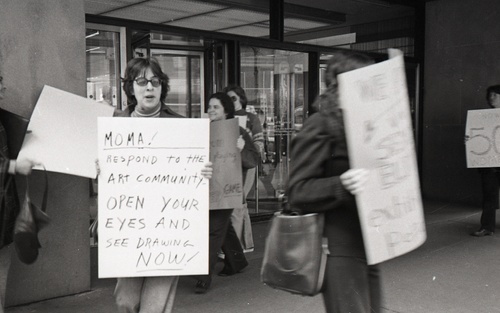
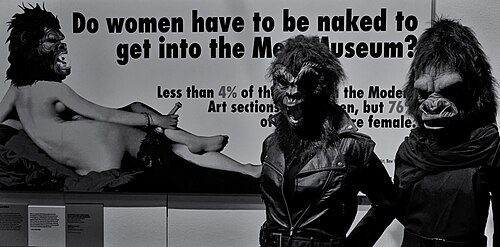
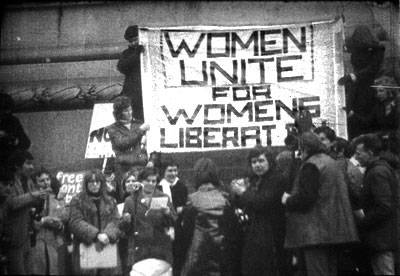
Over time, these institutional logistics began to shift, especially in response to feminist critique from the 1970s onward (Block). Block’s Women Demonstrate at MoMA argues that women artists had to publicly protest MoMA in 1972 to force the institution to acknowledge women’s exclusion and to demand structural change in museum representation. She provides first-person accounts of the protest through descriptions of the picket line, MoMA’s responses, and references to discrimination statistics distributed by Women in the Arts. The article offers documentation of feminist activism directly targeting MoMA and shows that underrepresentation was not only visible to the public but was actively fought. This source gives historical evidence of how MoMA’s institutional structures prompted action by women artists, thus raising the questions of whether such efforts to address gender imbalance signify genuine institutional recognition or mere gestures toward inclusion driven by external pressures.
This kind of active resistance has clearly been effective. Nancy Princenthal’s Feminism’s Future Explored at MOMA argues that there has been a significant revival of interest in feminist art and women’s representation in museums, with institutions like MoMA recently hosting unprecedented programs and exhibitions dedicated to women artists (Princenthal). It uses evidence from major touring surveys, scholarly symposia, exhibitions such as WACK! Art and the Feminist Revolution, and references to historic protests and events that addressed the underrepresentation of women, including statistics from advocacy groups like the Guerrilla Girls. The resource matters because it highlights an ongoing shift in institutional attitudes, showing both progress and shortcomings in the recognition of women artists, which remains relevant to discussions about equity and visibility. The article shows how MoMA moved from being a target of protest due to poor representation of women to actively engaging with feminist art, suggesting that institutional recognition has improved, but also that change is slow and requires continued collective effort. This helped draw attention to disparities in artwork acquisition, display, and leadership. Feminist art historians like Pollock herself also helped reshape academic discourse, challenging the very basis of the modernist narrative and calling for the inclusion and support for marginalized artists. By the late twentieth century, these pressures had begun to influence MoMA’s collecting and exhibition strategies. The publication of Modern Women itself was part of a broader attempt to address and correct the museum’s historical gaps and establish women within the narrative of modern and contemporary art. However, Pollock makes it clear that recognition did not just mean adding women to pre-existing categories but also rethinking how the story of modernism is told. She argues that integrating women into the narrative requires the assumptions that once made their exclusion seem inevitable to be re-examined.
Photograph by Burt Glinn / Magnum
Copyright held by the Estate of Mary Beth Edelson
Rethinking Modernism: Beyond Adding Women
From the early 2000s onward, the MoMA made more deliberate efforts to expand its collection of women artists, revisiting past acquisitions and initiating new purchases that diversified the collection. According to the Artsy article, New MoMA Show Unearths Female Abstractionists That Have Languished in Storage, the resource argues that a new MoMA exhibition is actively working to correct historical neglect by bringing to light the work of female abstractionists whose art had been previously relegated to storage (Artsy Editorial). The article uses as evidence the specific artists and artworks featured in the exhibition, which had been physically hidden from public view for decades. These changes reflect a clear acknowledgment that its earlier narratives were incomplete. Nonetheless, as Pollock emphasizes, true recognition requires more than just numerical inclusion, it requires conceptual changes. Women must not simply be added as an afterthought, but understood as shaping modernism in ways that fundamentally altered how the movement is defined. Duncan’s critique remains relevant even here: even as more women enter the collection, the museum must also reevaluate how it frames the works of famous male artists and the gendered assumptions embedded into their interpretation. Therefore, institutional recognition is both quantitative and interpretive because it involves acquiring women’s works and making sure they are included in the narrative.
By studying the process of how the MoMA’s collection of female artists has changed over time, we have clearly understood how the institution’s collection decisions reflect and shape the cultural power structure. This indicates that the narrative of art history is not objective but is constructed. The classics, masters, and art history that we accept did not form naturally; instead, they were actively constructed by authoritative institutions like MoMA through a series of biased choices. And data can become a tool to challenge this narrative and retrieve the forgotten voices. The cultural environment we are in is not formed by chance; it is the result of power operations. However, our project also shows that this structure is not impregnable – it can be analyzed, questioned, and changed. And each of us has the ability to reshape it through critical questioning, thus ensuring the formation of a more just and inclusive cultural memory. In summary, what we hope to help others understand is a crucial awakening, namely, the questioning spirit and the courage to seek truth that should be possessed when examining any authoritative narrative. This spirit and courage are what everyone should possess.